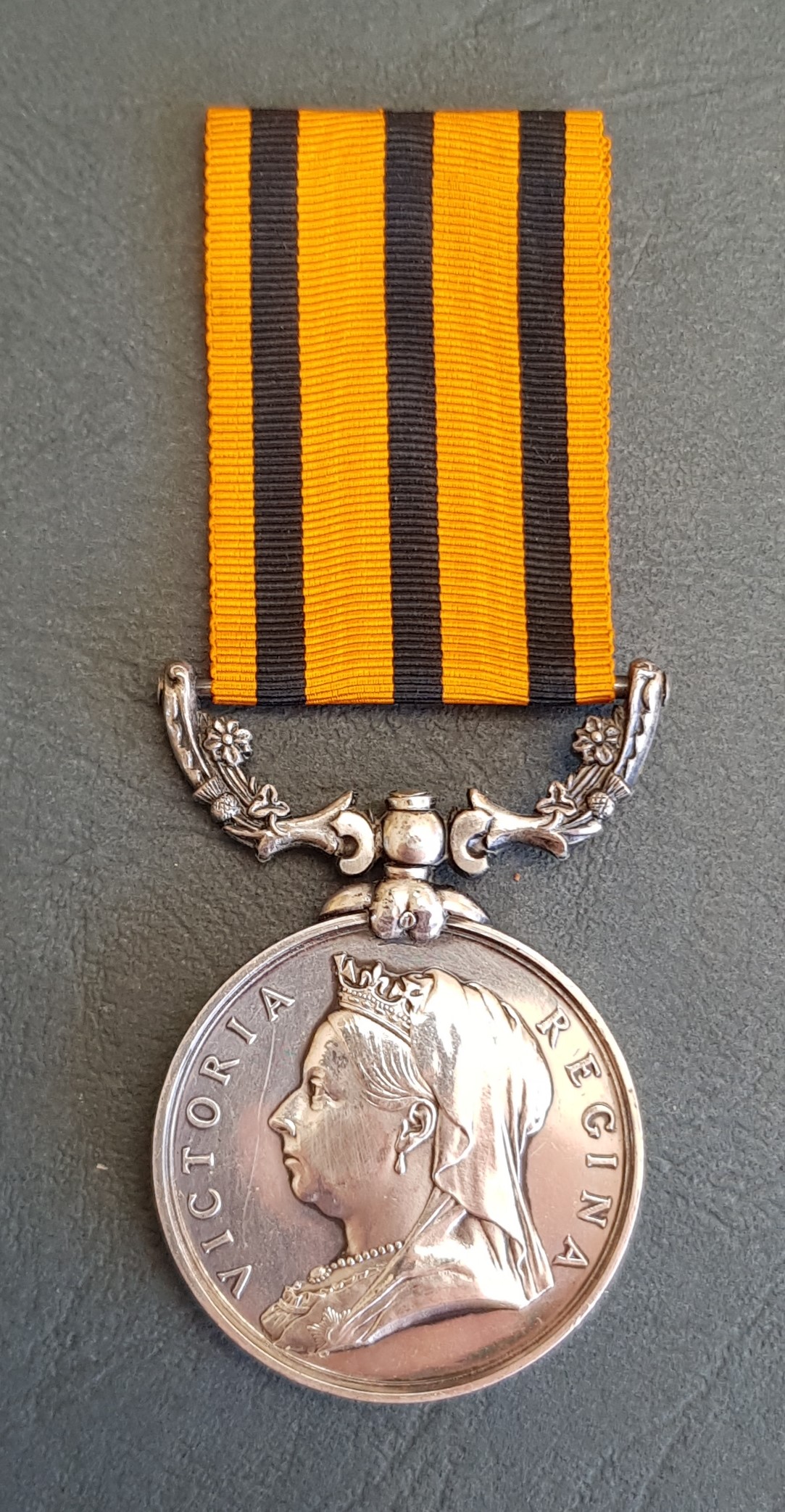
British South Africa Company Medal, Rhodesia 1896 reverse (TPR. J.M. DE WINTON, UMTALI VOLS.) - correctly named in partial italic and upright scripts.
John De Winton was born into an ancient English family. Born on Norfolk Island on 10 March 1852 he was the son of (at the time of his birth) Lieutenant George Jean De Winton of the 99th Regiment and his wife Fanny, the daughter of Thomas White Melville Winder of New South Wales in Australia.
De Winton came from solid military stock; his father was the son of Captain George de Winton, of Heywood Hall, D.L. for Somerset and had entered the army in the year 1841, at the age of seventeen, as an ensign in the 99th Regiment. In 1843 he had embarked for Hobart Town in the barque Constant, in command of a convict guard.
Landing the prisoners at Hobart Town, the vessel proceeded to Sydney, and the detachment joined the headquarters of the regiment at Parramatta. The Home Government, yielding to the strong opposition of the colonists of New South Wales to the formation of the projected penal settlement, it was abandoned, and the expedition returned to Sydney. Lieutenant de Winton was then sent in command of a detachment to Brisbane, being at the same time nominated on the commission of the peace.
In 1848 the detachment was withdrawn from Brisbane, and after a short period of service with the headquarters in Sydney, Lieutenant de Winton proceeded with a detachment of the regiment to Norfolk Island, remaining there for eighteen months, returning to the island for another two years, after an interval of service at Hobart Town. It was during his second stint of service on the island that John Massey was born.
In 1853 Lieutenant de Winton was invalided from the island, and granted two years' sick leave. A sea voyage to England having much restored his health; he applied for employment, and was selected to form a recruiting subdivision at Preston. In 1854 Lieutenant de Winton was promoted, and went to command the depot of his regiment at Chatham, and subsequently to command a detachment at Harwich.
This was the world into which John was born. He had many siblings, George William Wade De Winton born in 1849, Isabella Fanny De Winton born in 1850, George William De Winton born in 1856, Laura Jane Agnes De Winton born in 1858, Marie Christine Jessie De Winton born in 1860, Katherine Alice Annie De Winton born in 1864, Eleanor Julia De Winton born in 1867 and Anita Dora De Winton born in 1871 and it was small wonder that he fled the coop at some point although quite when this happened is a mystery as little is known about his early life.
He was, it seems possessed with a pioneering and adventurous spirit which is probably what led to him being in Africa at the time of the 1896 Matabele Rebellion. Enlisting with the Umtali Volunteer Corps he saw service with them as a Trooper. The Volunteers were raised by Colonel G. Hamilton Browne and were a body of men whose primary function was to protect the lives and property of settlers in the Umtali area who were under threat of attack by the marauding tribesmen hell-bent on destroying European influence.
They had a busy war – according to the British South Africa Company Reports on the Native Disturbances in Rhodesia 1896-97 they were especially active in Makoni’s district which covered a wide swathe of land surrounding the settlement of Umtali.
From 31 July to 3 August 1896 the Umtali Volunteers, 92 in number, were involved in the skirmish on Devil’s Pass range where several kraals were burnt but “not many” natives killed. In this incident the Native Commissioner was attacked by a body of natives and some shots were exchanged but the rebels dispersed when reinforcements arrived.
At Makoni’s Kraal itself on the 3rd August 40 of the Umtali Volunteers were part of the force which captured 353 cattle and 210 goats and sheep accounting for 200 of the enemy’s number including his witchdoctor. On this occasion 4 white men were killed and 4 wounded. This was followed up, at the same location, on 4 September when Makoni was captured in an attempt to escape from the caves in which he was hiding. He was tried by Court Martial and shot on the following day. On this occasion the Volunteers had combined with the West Riding Regiment to affect his capture.
40 of the Volunteers were also in action at Manyerbeera’s Kraal from the 2nd to the 9th of October where at least 15 natives (some say many more) were killed and several kraals burnt for the loss of 1 white man who was wounded and another that died of wounds later. Later that month, from 19 to 26 October, 52 of them were in the column that saw six days fighting at Gatzi’s Kraal. In this skirmish Major Evans of the M.R.F. was killed along with one white man and another who was wounded. The force accounted for 16 who were known to have been killed although it is believed that many more succumbed. (It was always difficult to determine exact numbers as the enemy carried away their dead and wounded) The women and children had been ordered to come out from the cave in which they were hiding before the fighting began.
After the dust had settled De Winton was awarded the B.S.A.C. Medal named to the Umtali Volunteers.
Scouting around for something to occupy himself with he soon found himself in Natal where, on 19 May 1898 he “enlisted by order” with the Natal Police at Pietermaritzburg and was assigned the rank of Trooper and no. 2142. The spelling of his middle name, always controversial, was Massie on this occasion and not the Massy we are accustomed to.
As next of kin he provided the details of his father, Major Winton of the Junior United Services Club, London. Interestingly the comment “papers to be procured” appear next to his entry in the NP muster book. Could the fact that he was discharged for misconduct on 30 June 1898 (one month after he joined) be on account of what appeared in his papers once they had arrived?
After his laughably short service with the Natal Police De Winton made his way back to Rhodesia where, on 10 August 1899 he joined the ranks of the Rhodesia Regiment at Salisbury with no. 352. Again De Winton didn’t hang about for long – after less than a full week he was discharged as Medically Unfit on 16 August.
This was less than two months before the outbreak of the Anglo Boer War between the Transvaal and Orange Free State Republics on the one hand and the might of the British Empire on the other in October 1899 but De Winton, probably deterred from an early application because of his previous experience, waited until the 14th January 1901 before enlisting with the 1st Kitchener’s Fighting Scouts with no. 870 and the now familiar rank of Trooper.
Living at Bulawayo in Rhodesia when he joined up he was now 41 years of age and had “an Arrow wound to his right chest”. Where he had picked this wound up is a matter for conjecture but it could well have been during the fighting he had in the Matabele Rebellion five years previously.
Seven months later, on 28 August 1901 he was discharged from his unit “to pension” at Cape Town. This wasn’t to be the end of his exploits however, as he reappeared on 23 February 1902 at Green Point in Cape Town to offer his services to the cause this time as a Trooper with the South African Mounted Irregular Forces assigned no. 41385. On this occasion his papers tell us that he had a dark complexion, grey eyes and brown hair. By way of distinctive marks he still sported his Arrow wound scar on his right chest.
On 21 April 1902 De Winton was transferred to the 2nd Kitchener’s Fighting Scouts where he saw service until the disbandment of that unit on 23 July 1902 – some three months after the cessation of hostilities.
A careful scrutiny of the many medal rolls whereupon his name appears has proved to be inconclusive as to whether or not he was ever issued with a Queens Medal.
After his discharge De Winton appears to have made his way back to England to visit family before, in 1906 undertaking his last big adventure. On 9 March of that year he boarded the “Orontes” at Southampton as a 3rd Class passenger bound for Brisbane in Queensland, Australia. At the age of 49 he described himself as a Coffee Planter by occupation. The Division of Herbert in 1908, according to the Voter’s Roll has him listed as a Planter resident at Farleigh.
On 26 December 1908 John Massy De Winton, aged 56 breathed his last. He is buried in the local cemetery. Was he the black sheep of an otherwise prominent family? We will never know.
Medal is in good condition unless otherwise indicated. Sold with extensive research.