The Second Boer War
The Second Anglo Boer War officially commenced on 11 October 1899. This war which would be, according to some in the British Military, “over by Christmas” was to drag on for over two and a half years until peace was finally declared at the Treaty of Vereeniging on 31 May 1902.
A conflict between the two Boer Republics of the Orange Free State and her neighbour the Transvaal (Zuid Afrikaansche Republiek), it had its roots in the abortive Jameson Raid of 1896 where Cecil John Rhodes and others tried to usurp the sovereignty of Paul Kruger’s mineral-rich Transvaal in an effort to increase the British footprint in the region and to, so the claim was made, provide relief to the thousands of “Uitlanders” (foreigners) who formed the backbone of the hugely lucrative gold mining industry by extending the franchise to those who contributed the most, tax-wise, but who had no voice or representation in the running of the country.
The Boer ultimatum to remove all British troops on the borders of the two independent Boer republics, was rejected with the Boers crossing over into the Crown Colonies of the Cape and Natal the very next morning. Within weeks three major towns had been invested by Boer Commandos - highly mobile, citizen-soldiers who were, for the most part, Farmers – these were Ladysmith in Natal and Kimberley and Mafeking in the Cape Colony.
It was immediately apparent that the number of Regular Army personnel on the ground in the country was woefully inadequate to not only repel to but to defend against a determined and skilled foe. As a result, a series of three military reverses were experienced by the British in the month of December 1899. These were known as Black Week and appalled the citizenry at home who had grown accustomed to military conquests under Queen Victoria’s reign.
The war was waged in two distinct phases – the full-scale, pitched battle phase where British troops and Cavalry were ranged against Boer Commandos in a typical war format; and the second or guerilla phase which commenced after the Battle of Bergendal on 27 August 1900. In this latter phase the Boer Commandos were split up and fragmented into small, highly mobile units who undertook “hit and run” type operations against isolated British patrols and Lines of Communication. Increasingly desperate for food, uniforms, arms and ammunition they would plunder what they could carry and gallop off into the distance before relief could arrive for the harried British forces. Unable to retain any prisoners, they would often strip their captives down to their undergarments and let them lose on the veld to make their own way back to friendly lines!
The liberation and occupation of the Boer capital cities of Bloemfontein and Pretoria by the middle of 1900 did not mean that the war was over. The Boers simply moved their governments by train to another town or village.
In an effort to bring the war to a speedy conclusion, Britain responded with the scorched earth policy. This inhumane and widely condemned policy involved the uprooting of Boer women and children from their farms and their incarceration in hastily erected concentration camps dotted around the veld. Simultaneously, the troops would raise the homestead and any outbuildings to the ground, capture or slaughter any and all livestock and burn whatever crops were to be found. The thinking behind this was to prevent the Boer families – their support structure – from providing their fighting men with provisions.
All of the above was designed to break the indomitable Boer spirit and hasten their surrender. In the process, the British military obliterated the infrastructure of the South African Republic and the Orange Free State – something that would take decades to repair.
The camps referred to were, initially, poorly managed and massively overcrowded resulting in primitive sanitation, meagre rations and malnutrition, and disease outbreaks. 8,000 Boer civilians and 14,000 to 20,000 Black South Africans died, 81 percent of these were children.
Despite all of the above the war raged on. Drives and Blockhouses were a new strategy employed to break the Boer resistance. The drives were columns of British troops, aided by colonial units, who would traverse the length and breadth of the Orange Free State and the Transvaal in an all-out effort to hem the Boer Commandos in, thereby bringing about their demise. The Boers simply adapted their modus operandi and managed to find the gaps in the British “wall” and escape to fight another day.
The Blockhouses were an attempt to assist the drives referred to. They were constructed at regular intervals throughout the countryside and, protected by barbed wire and manned by British troops, they were designed to further frustrate and contain the Boers. Eventually, worn-out, with ammunition spent and most virtually in rags (some captured Boers were found wearing dresses and bonnets), the Boers sat around the table and voted for peace.
The conflict concluded on May 31, 1902, with the signing of the Treaty of Vereeniging. While it was a decisive British military victory, it came at a massive financial and human cost.
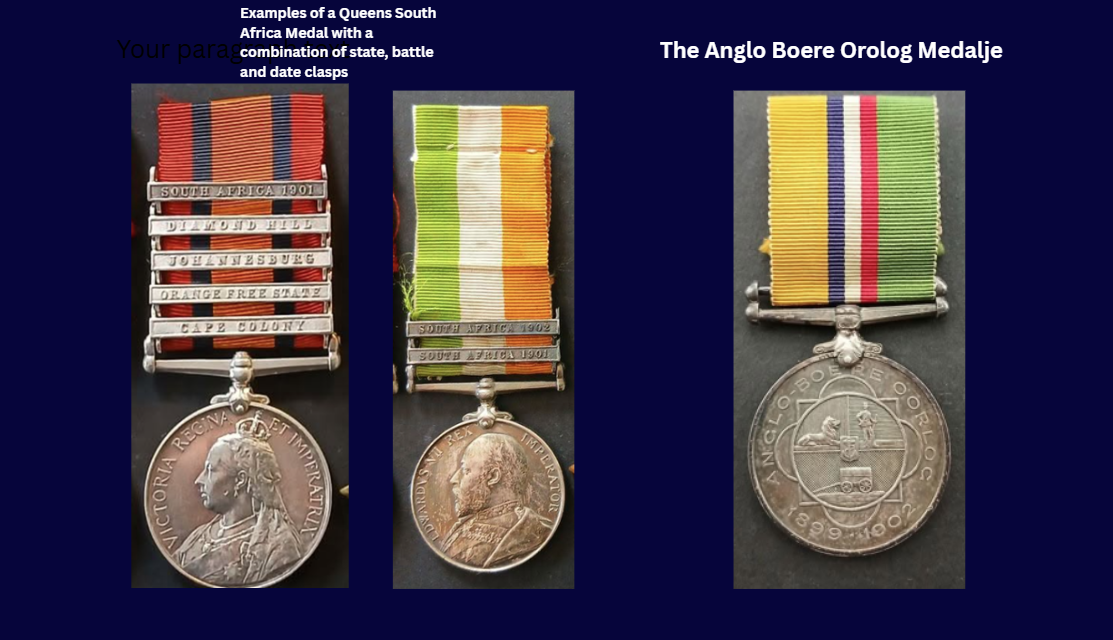
Two medals were awarded to the British for service during the war as it spanned the lifetime of two British Monarchs. The Queen’s South Africa Medal was Instituted in 1900 by Queen Victoria, awarded to military personnel, official civilians, and war correspondents who served in South Africa between 11 October 1899 and 31 May 1902. The medal was usually awarded with a combination of clasps, reflecting in which theatre of the war the man served. There were 26 QSA clasps awarded which were divided into three distinct categories: State eg. Cape Colony, Transvaal, Orange Free State; Battle e, g. Belmont Defence of Mafeking, Paardeberg etc. and Date, South Africa 1901 and/or 1902.
The King’s South Africa Medal was instituted in 1902 by King Edward VII, this medal recognized prolonged service. It was never awarded independently; it was always paired with the QSA for those who served in the theatre for at least 18 months and explicitly completed service during 1901 and 1902.
A third medal was awarded to the Boer forces called The Anglo Boere Orolog Medalje.
Written by Rory Reynolds, Collectors Department and Researcher.